One of the most common questions I’ve gotten working with health and fitness professionals is: “Can I actually talk to my clients about that?”
Whether it’s a client asking for a meal plan to manage their pre-diabetes, or a client crying on the gym floor because of work stress, the modern Personal Trainer is constantly pushed to the edge of their “Scope of Practice.”
We are in a strange transition period in the fitness industry.
• The Market is demanding “Holistic Health Strategists.” Clients don’t just want sets and reps anymore; they want help with sleep, stress, hormones, and longevity.
• The Law is still stuck in 1995. Regulations for Dietitians and Psychologists are strict, and crossing them is a liability.
So, how do we as fitness professionals solve specific health problems for our clients without pretending to be doctors?
The answer isn’t to break the barrier. It’s to reframe your role.
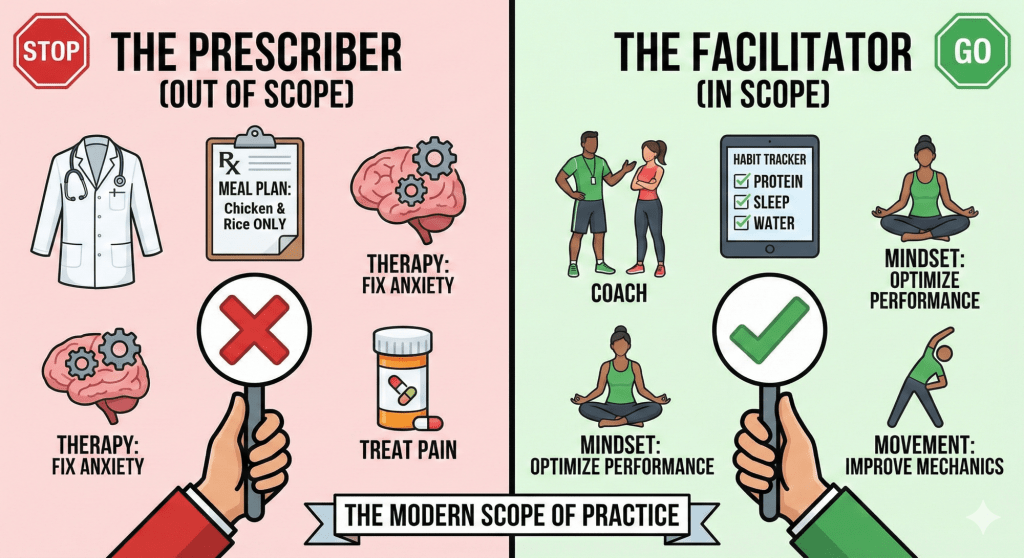
The Shift: From “Prescriber” to “Facilitator”
The boundary often isn’t about what topic you discuss; it is about how you deliver the information. The “Generalist” trainer gets in trouble because they try to prescribe. The “Specialist” trainer wins because they coach.
Here is the difference we teach our students:
1. Nutrition: The “Habit” Approach
• The Trap: Writing a detailed meal plan. “Eat 150g of chicken and 1 cup of rice at 6 PM.” This is Medical Nutrition Therapy.
• The Win (Coaching): Teaching habit stacking. “Current guidelines suggest increasing protein to support muscle repair. Let’s look at your day—where is the easiest place for you to add 20g of protein?”
• You aren’t prescribing a diet; you are coaching the behavior of eating.
2. Mindset: The “Performance” Approach
• The Trap: Analyzing trauma. “Your anxiety comes from your childhood.” This is Therapy.
• The Win (Coaching): Performance mindset. “It sounds like stress is killing your sleep, which is stalling your recovery. Have you tried breathwork tools to downregulate your nervous system post-workout?”
• You aren’t fixing their past; you are optimizing their future performance.
Be “The Hub,” Not the Hero
I actually believe the future of fitness belongs to the “Project Manager of Health.”
You don’t need to be the hormone specialist or the therapist. You need to be the expert who recognizes the issue and manages the solution.
The Role of Education
To navigate this nuance—to know exactly where the line is and how to walk right up to it safely—requires specific education.
Whether it’s mastering Menopause Coaching or learning Behavioral Psychology, the “Scope of Practice” expands when your knowledge deepens.
The future belongs to the Educated Coach.
 Ai Fit Pro
Leave a comment